
The Big Picture
For a scaling healthcare practice, a lease is just a monthly expense by default. But when structured correctly by a Fractional VP of Real Estate, that same lease transforms into a high-leverage financing vehicle.
In a 2026 market where venture equity is expensive and dilution is permanent, I help founders stop "spending" their cap table on drywall and start using their landlord's capital instead.
Why It Matters: The True Cost Comparison
Most founders focus on the lowest possible rent. However, the smarter move is often a higher rent paired with a massive Tenant Improvement Allowance (TIA).
❌ The Old Approach
Result: You spend $300K-$500K of your own capital on build-out. That's equity you'll never get back.
✓ The Strategic Approach
Result: The landlord funds most of your build-out. You preserve capital for hiring and patient acquisition.
1 Liquidity is Your Insurance Policy
Why This Matters
Move faster on the build-out without waiting for the next tranche of funding.
Keep reserves for unplanned changes as your clinical model develops. We build in "contingency logic" so that if your clinical model pivots during the build-out, you aren't out of pocket for the redesign.
Protect your "burn" for hiring and patient acquisition—the things that actually drive your valuation.
How I structure this as your Fractional VP: I negotiate TIA packages that cover 70-90% of your hard costs, with specific provisions for MEP upgrades, medical gas, and specialized HVAC—the expensive infrastructure that landlords are willing to fund because it adds permanent value to their asset.
Strategic Pro-Formas: I stress-test construction estimates against your raise to ensure the TIA covers the "surprises"—those inevitable change orders that blow up budgets. By modeling best-case, expected, and worst-case scenarios, we ensure you're never caught short when the unexpected happens.
2 The "Retail" Reality: You Are Planting a Flag
In healthcare, you are "marrying" your building. Unlike a tech startup that can pivot to remote work, healthcare is retail.
The Switching Cost Problem
High Switching Costs: Moving even 5–10 minutes away can cause a significant drop in patient retention.
Sunk Costs: The specialized nature of medical build-outs makes moving cost-prohibitive. You can't just take your medical gas lines and HVAC upgrades with you.
The Strategy: Negotiate Flexibility Today
The landlord won't give you a "second bite at the apple" for mid-lease renovations. I help founders build in expansion rights, layout flexibility, and future equipment provisions in the initial lease—not as afterthoughts.
Flexible Design Philosophy: I advocate for layouts that allow for incremental changes, ensuring you don't need a second TIA to stay relevant in year five. This means modular exam rooms, adaptable equipment zones, and infrastructure that can support future clinical pivots.
California-Specific Challenges:
- → HCAI Compliance: I manage the specialists needed to navigate California's Office of Statewide Health Planning and Development requirements, ensuring your design meets state-level healthcare standards from day one.
- → Seismic & Zoning: California's seismic requirements and complex local zoning codes make mid-lease changes exponentially more expensive. Getting the structural and spatial design right initially isn't optional—it's survival.
3 The Letter of Credit (LC) Burn-Down Strategy
⚠️ The Catch
Landlords won't fund a heavy medical TIA without security. For a startup, this usually means a cash-collateralized Letter of Credit—essentially trading your liquid venture cash for "frozen" bank assets held by the bank to guarantee the lease.
A standard $500K security deposit sits locked in a bank for 10 years. That's $500K you can't use for hiring, marketing, or expansion.
✓ The Burn-Down Solution
Treat the Letter of Credit as a dynamic financial instrument with burn-down provisions that evolve with your company's growth, rather than a static deposit.
The Key Insight: When you pay a contractor, that money is gone. When you secure an LC, that money is still on your balance sheet—it's just "restricted." As your Fractional VP, my job is to liberate that capital.
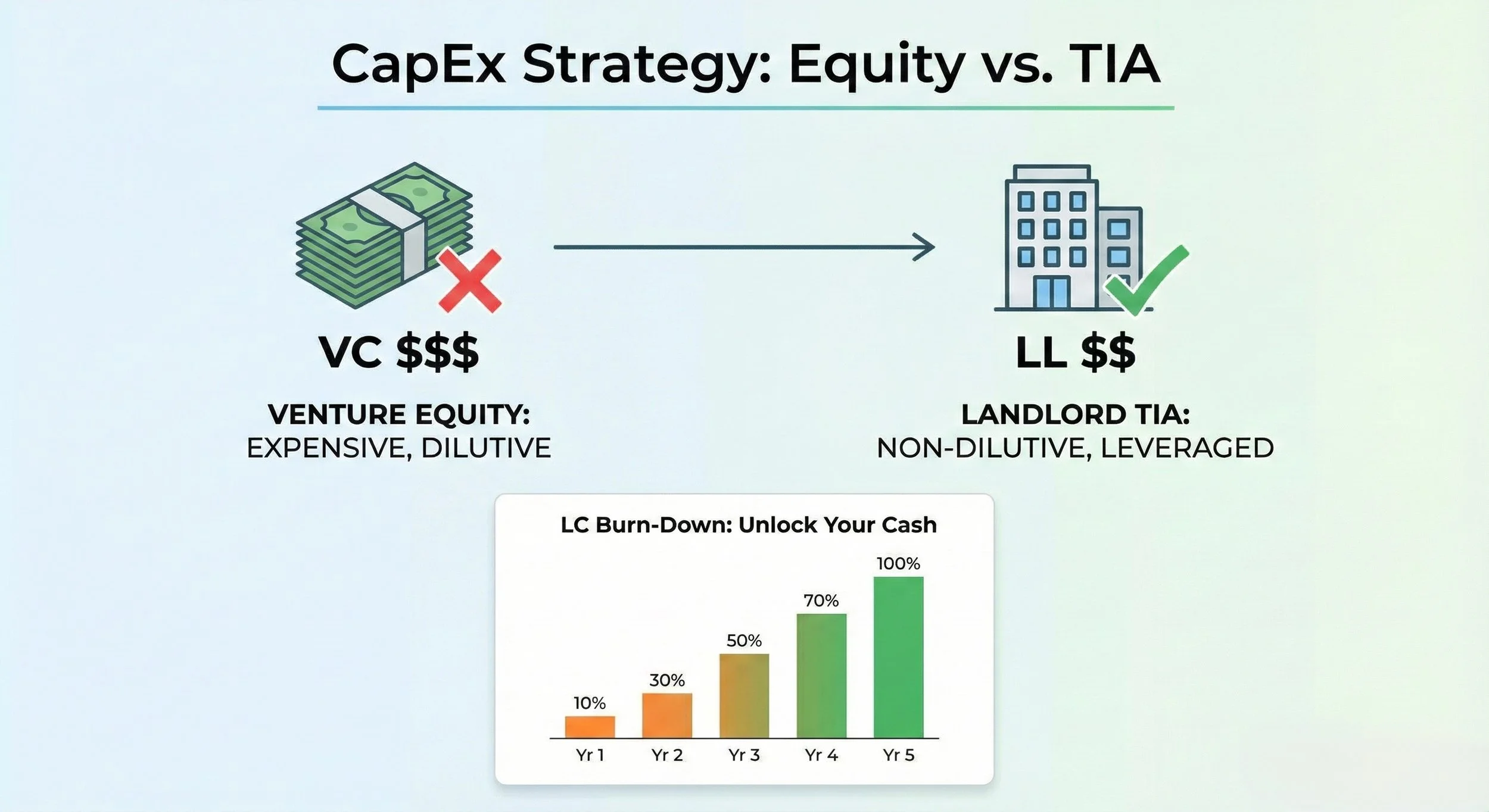
Strategic LC Burn-Down: How to free up capital as you hit operational milestones
The Financial Engineering Behind the Burn-Down
LC stays at full amount while you prove operational viability. This is your "trust-building" period with the landlord.
LC reduces by 25-50% as you hit specific milestones: reaching target patient volume, maintaining timely rent payments, or closing a new funding round. You now have cash freed up for Site #2.
LC steps down to a minimal cash deposit. By this point, we can often unlock 50% or more of that frozen cash, funneling it back into your operations when you're ready to scale.
My goal is always to protect the founder. We use the LC as the shield so your personal assets never enter the conversation.
How I negotiate this: I structure LC agreements with specific reduction triggers tied to EBITDA, patient volume, operational benchmarks, or new funding rounds. This turns your security deposit into a financing tool that funds your next location—what I call "Liquidity Velocity."
The Bottom Line
In 2026, investors are looking for capital efficiency. Every dollar the landlord spends on your facility is a dollar of equity you keep on your cap table.
Stop negotiating just the rent—start negotiating the timing of your cash.
When you structure your lease as a financing vehicle rather than just an occupancy cost, you transform real estate from a liability into a strategic asset that funds your growth.
Ready to Build Your Scaling Strategy?
Real estate is the largest fixed expense on your balance sheet—don't treat it like an afterthought. Whether you're preparing for a Series A or planning a multi-site rollout in California, you need a strategy that protects your cash and your equity.
As your Fractional VP of Real Estate, I help healthcare founders navigate the transition from "clinical vision" to "operational reality" by securing the capital and the sites they need to scale.
