
You're a healthcare founder raising capital for the first time. You have a disruptive care model, proven market demand, and a stellar team. But in the final moments of the pitch, the conversation pivots away from your clinical vision and straight to your balance sheet.
The Question That Determines Your Funding
This question is a high-stakes test of your unit economics and execution certainty. Real estate costs often represent the largest cash burn outside of payroll—and an unquantified plan signals high risk.
The investor needs proof that you have total command over the true, all-in cost of your de novo expansion.
This guide is designed to help you prepare the four strategic answers investors demand, transforming your real estate costs from a high-risk liability into a defensible strategy for scale.
The Four Strategic Pillars of De Novo Healthcare Fundraising
Your Investor-Ready Framework
Master these four pillars to convert vague aspirations into quantifiable, defensible answers:
Market Selection & TAM
Space Programming
Interior Design
CapEx Certainty
1 Market Selection and TAM: Proving Your Site Strategy
The most important step for investors is proving that the market opportunity is large enough to generate "outsized returns." Your site strategy must directly link the physical location to defensible revenue targets.
Your Expert Answer: This is your first number. You must reverse-engineer the required Patient Panel Size (or annual patient visits) based on your projected revenue per patient, overhead, and OpEx (which includes rent). This proves your care model is financially viable before site selection begins.
Strategic Metric to Use: Required Patient Panel Size — The minimum patient volume needed to cover OpEx and achieve profitability.
Your Expert Answer: Define the Serviceable Available Market (SAM) as the total target population. Define your Trade Area as the specific geographic component of the SAM (e.g., within a 15-minute drive radius) that you can realistically serve.
Strategic Metric to Use: Trade Area Definition — The specific geographic boundary (e.g., 15-minute drive time) linked to demographics and payor mix.
Your Expert Answer: Your market capture assumption must be defensible. Going in with an assumption that you need to capture >5% of the target Trade Area population is a major red flag, signaling an unrealistic growth model. Determine a conservative, achievable market capture percentage based on existing competitor penetration.
Strategic Metric to Use: Feasible Market Capture Rate — The low, defensible percentage of the Trade Area required to reach the Required Patient Panel Size (ideally ≤3%).
Your Expert Answer: Prove the location is a deliberate financial strategy. The Payor Mix Composition (Commercial/Private, Medicare, Medicaid) directly determines your profit margins and the valuation multiple applied to your business.
Strategic Metric to Use: Payor Mix Composition — The percentage breakdown of revenue by payor source, proving revenue quality.
2 Space Programming: Validating Scalability and Efficiency
Investors require confidence that your operational model is repeatable and that every dollar of capital is spent efficiently. Your space program must prove you understand the true operational footprint.
Your Expert Answer: The single most common failure is severely under-programming the different room types required. Founders consistently miss essential support spaces for code compliance and operations, such as Janitorial, Biohazard Waste, dedicated IT/Data Rooms, and minimum compliant Restrooms/Storage. Your program is the product.
Strategic Metric to Use: Total Square Footage per Revenue-Generating Unit (SF/RGU) — Proves asset utilization across all services (exam rooms, labs, diagnostics).
⚠️ The Downstream Financial Impact
Underestimating your true required square footage has a direct, detrimental impact on your financial projections. If your actual space requirement is 20% higher than projected, your financial model is instantly flawed because both your projected monthly rent (OpEx) and your construction CapEx are 20% too low.
This signals massive execution risk to an investor.
Critical Metric: Variance of Projected vs. Actual Square Footage — A high variance signals unreliable financial modeling and execution risk.
Your Expert Answer: Show that you have a standardized space program for every new site (a "design kit") that ensures repeatable patient flow, reduces design costs for new locations, and accelerates speed-to-market.
Strategic Metric to Use: Design Cycle Reduction — Reduction in time and cost to produce construction documents for sites 2, 3, and 4 compared to Site 1.
3 Interior Design: Driving Patient and Staff Outcomes
Interior design in healthcare is a strategic asset, directly impacting two massive OpEx risks: staff turnover and patient attrition. Investors want to see that design mitigates operational costs.
Your Expert Answer: The biggest operational cost is staff turnover. Investing in staff comfort and restorative spaces (premium break rooms, quiet areas, natural light access) directly mitigates burnout and retention risk, reducing massive OpEx costs associated with hiring and training.
Treating the staff break room as an asset, not an afterthought, avoids the stress and tension that breed turnover.
Strategic Metric to Use: Staff Workflow Metric — Demonstrated reduction in miles walked per nurse shift or projected staff turnover reduction due to optimized space.
Your Expert Answer: Showcase design elements that drive loyalty and outcomes. This includes noise reduction (which affects sleep/stress) and biophilic features (natural light), which are linked to better patient satisfaction and outcomes.
Strategic Metric to Use: Patient Satisfaction (HCAHPS) Uplift — Projected increase in key satisfaction metrics due to enhanced design elements (noise control, privacy).
4 CapEx: De-Risking the Cash Burn and Proving Certainty
The final section of your pitch must prove you have absolute command over your capital expenditure timeline. Your strategic value is proving CapEx Certainty—a key signal of management quality.
Your Expert Answer: The decision between a Facelift (2nd Gen) and a New Build (Shell) dictates your financial model. Facelifts offer Speed-to-Market but introduce High CapEx Uncertainty. New builds offer CapEx Certainty (a predictable cost for a repeatable product) but mean Delayed Time-to-First-Revenue.
This trade-off must factor into your CAC and Revenue per Customer projections.
Strategic Metric to Use: Variance of Actual CapEx vs. Projected Budget — A low variance signals high management quality and control over cash burn.
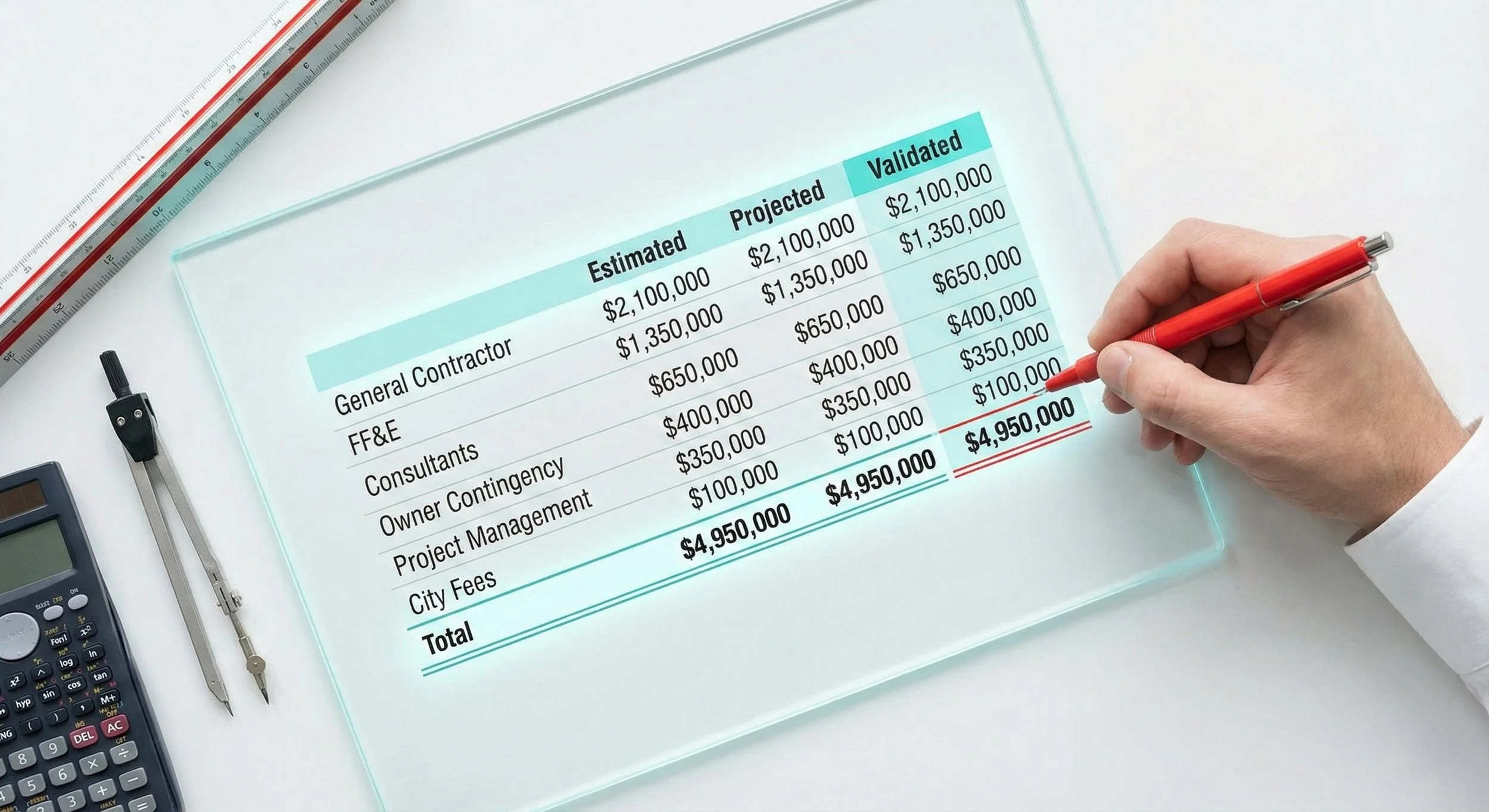
Your Expert Answer: The single most common budget error is underestimating FF&E (Furniture, Fixtures, and Equipment), including specialized medical equipment, by 20-30%. Your CapEx must be comprehensive, listing construction plus equipment, technology (EHR/EMR), and pre-opening operational costs.
Strategic Metric to Use: Non-Construction CapEx Percentage — The percentage of total project CapEx allocated to FF&E, technology, and soft costs (ideally 20-30%).
Your Expert Answer: Your CapEx timeline must show not just what you spend, but when you spend it. This includes the duration of design, permitting, construction, and equipment installation/lead times. This proves a realistic time-to-first-revenue.
Strategic Metric to Use: Time-to-First-Revenue (TTR) — The projected date of clinic opening, based on realistic lead times for construction and equipment.
Lock Down Your Pitch Deck
This framework shows you how to convert vague aspirations into quantifiable, defensible answers for investors. Your real estate strategy is the foundation of your execution story.
Ready to transform your real estate costs into a strategic asset for your next funding round?
Dial In Your Budget