
🚨 The AKS and FMV Pitfall: Why Free Space is a Felony Risk
Giving a referral source free or below-market use of your clinic space is illegal remuneration under the federal Anti-Kickback Statute, even for a single afternoon. Intent to "be a good partner" is no defense: if even one purpose is to induce referrals, the statute is violated. The fix is the Rental of Space safe harbor — a written agreement, a set term, rent set in advance, and Fair Market Value backed by an independent appraisal.
For a growing healthcare practice, the most dangerous risk isn't a high interest rate or a bad lease. It's a regulatory blind spot. You've found the right site, patient volume is climbing, and the moment you look for ways to "strengthen partnerships" through shared space, you walk into a high-stakes compliance minefield: the Anti-Kickback Statute (AKS).
This post is for informational and educational purposes only and is not legal advice. Retained CRE is not a law firm. Consult qualified legal counsel specializing in healthcare regulatory compliance for advice specific to your situation.
The most dangerous misconception
The most common misunderstanding among growing founders is the role of intent. They aren't trying to commit fraud; they're trying to be good partners and make things easier for patients and colleagues. That good-faith effort is exactly where the compliance risk explodes.
Can you let a referral source use your space for free?
The conversation usually goes like this: "Of course, use our conference room for your sales meeting. We have it available, it's convenient, and it strengthens the partnership." It sounds like common sense. Under the AKS, it can be a felony.
The "one purpose" test
If one purpose of the arrangement is to induce referrals, the statute is violated. The law does not care that 99% of your intent was convenience and partnership; if the remaining 1% was to encourage patient referrals, the arrangement is illegal. Intent doesn't matter. Structure does.
That disconnect — between a simple action like lending a room and a serious felony penalty — is why founders must pause the moment they consider letting a referral source use their space.
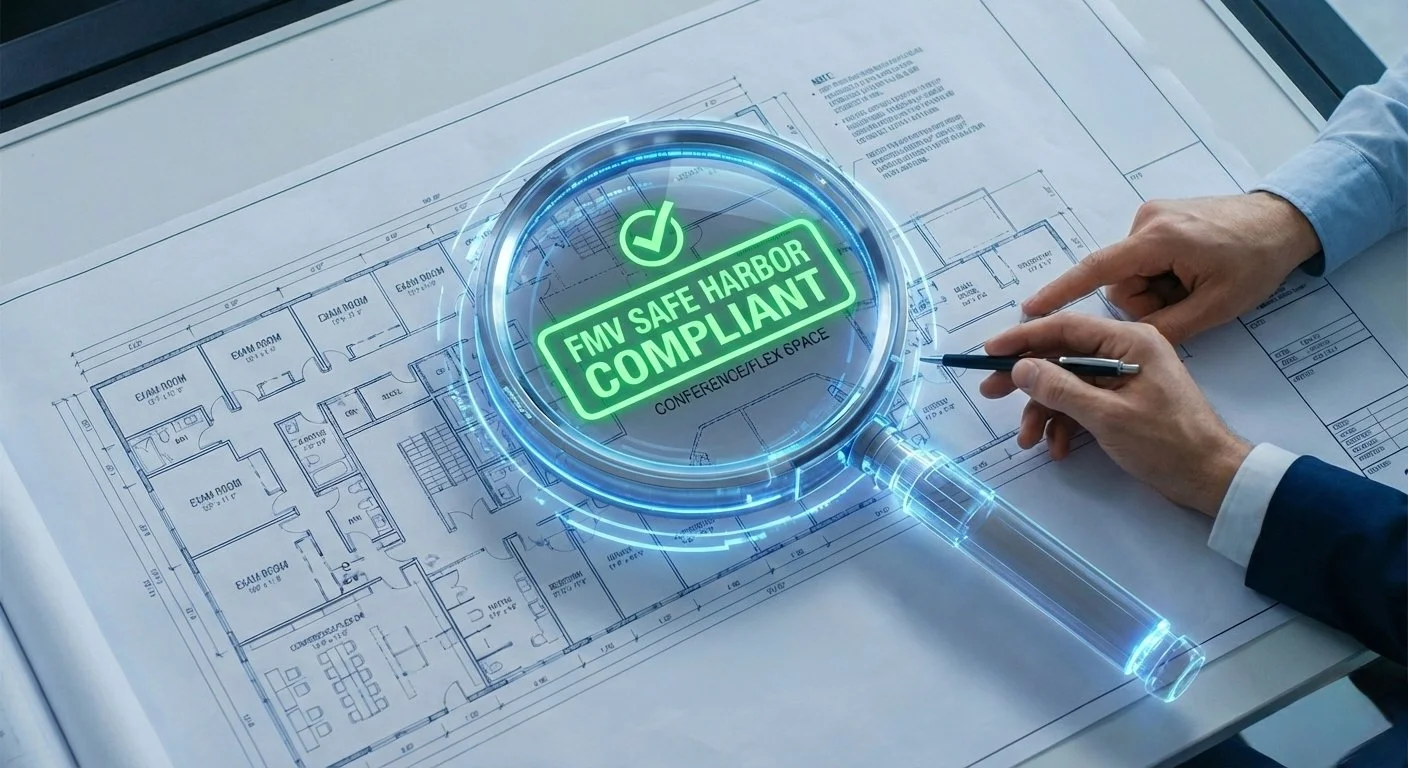
The AKS compliance framework: the path from convenience to felony risk.
Why is giving away free space an Anti-Kickback violation?
Free space is one of the most common forms of illegal remuneration in healthcare real estate. The value of the space, even for one hour, is remuneration in kind. This happens whenever a related entity — a referring physician, an affiliated insurer, a downstream partner — uses your clinic space for any purpose without paying Fair Market Value rent.
Common risk scenarios
The insurance trap. Letting an affiliated insurer use your conference room monthly for free sales or enrollment seminars.
The sweetheart sublease. Subleasing an exam room to a specialist who is a guaranteed referral source at rent below the true market rate for comparable space.
The shared-cost trap. Allowing an affiliated marketing or management group free weekend use of your waiting room for non-patient staff training.
In each case, the free or discounted use of the space is remuneration exchanged for the benefit of patient referrals. Free space is not a courtesy. It's illegal remuneration.
What is the Rental of Space safe harbor?
To avoid AKS exposure, the financial relationship must fit within one of the safe harbor regulations. For real estate, the relevant standard is the Rental of Space safe harbor. The lease terms that protect you here overlap with the ones I cover in LOI & Lease Negotiation.
To comply, the transaction must be
- In writing
- For a defined term
- Set in advance
- Conducted at Fair Market Value (FMV)
How do you set Fair Market Value for shared medical space?
Fair Market Value is the rent a lessee would pay a lessor in an arm's-length transaction, consistent with general market value, and not greatly above or below the cost of comparable office space. The trouble is that founders routinely calculate it wrong.
The most common mistake is using your own base rent as the FMV rate for a sublease with a related party. That fails to account for two things:
- Total occupancy cost. True FMV includes a pro-rata share of all operating expenses (taxes, utilities, CAM), not just the base rate.
- Short-term and partial-use premium. The rate has to reflect market value for limited or part-time use, which is typically higher per unit of time than a long-term full-service lease.
Your guardrail
To prove compliance, obtain an objective, third-party valuation — an independent FMV appraisal — for any license or sublease agreement with a referral source. Do not rely on internal calculations.
What about one-time or single-use events?
For short-term or single-use events, you need a License Agreement rather than a full lease, and the rate still has to be based on the FMV of the space on a per-use basis. A written agreement and an FMV payment are mandatory, even for an afternoon meeting.
Is compliance worth the cost?
When the risk gets raised, founders often object to the cost of compliance: "We have to pay legal fees to review a license agreement, and then collect FMV rent from the partner." But the cost of non-compliance is vastly higher than the cost of getting it right.
Non-compliance (AKS)
- Personal criminal liability: up to 10 years in prison
- Criminal fines up to $100,000 per violation
- Mandatory exclusion from federal healthcare programs — a financial death sentence
Compliance (FMV safe harbor)
- A flat legal fee to review and draft the license agreement
- The cost of an independent third-party FMV appraisal
- FMV rent collected from the partner, which offsets the appraisal and legal review
You're balancing the reward of gaining referrals against the risk of personal and professional ruin. Any time you find yourself thinking "this is low risk of getting caught," your compliance alarm should be sounding.
The line to use
Any time a potential referral source asks to use your space for a non-patient-care activity, the immediate answer is: "We need to structure this under a compliance safe harbor, which requires me to speak with regulatory counsel first." Don't let convenience today become a devastating liability tomorrow.
Key takeaways
- Under the AKS, if even one purpose of an arrangement is to induce referrals, it's illegal. Good intent is no defense — structure matters, not intent.
- Free or below-market space given to a referral source (physician, insurer, downstream partner) is remuneration in kind, even for a single afternoon.
- The Rental of Space safe harbor requires a written agreement, a defined term, rent set in advance, and Fair Market Value.
- Your base rent is not FMV. True FMV includes a pro-rata share of operating expenses plus a short-term/partial-use premium — backed by an independent third-party appraisal.
- Penalties reach up to 10 years in prison, $100,000 per violation, and exclusion from federal healthcare programs — far more than the cost of a license agreement and appraisal.
Frequently asked questions
Is it legal to let a referring physician use your office space for free?
No. Under the federal Anti-Kickback Statute, free or below-market use of your space by a referral source is remuneration in kind, even for a single meeting. If even one purpose of the arrangement is to induce referrals, it violates the statute. To be compliant, the use must be documented and paid for at Fair Market Value under the Rental of Space safe harbor.
What is the "one purpose" test under the Anti-Kickback Statute?
The "one purpose" test means that if even one purpose of an arrangement is to induce or reward patient referrals, the Anti-Kickback Statute is violated, regardless of any other legitimate purposes. So an arrangement that is 99% about convenience and partnership is still illegal if 1% of the purpose is to encourage referrals. Intent to be helpful does not protect you; structure does.
What is the Rental of Space safe harbor?
The Rental of Space safe harbor is the AKS provision that protects real estate arrangements with referral sources when four conditions are met: the agreement is in writing, it runs for a defined term, the rent is set in advance, and it reflects Fair Market Value. Meeting all four shields the arrangement from Anti-Kickback liability; missing any one of them leaves it exposed.
How do you determine Fair Market Value for shared medical space?
Fair Market Value is the rent a tenant would pay in an arm's-length deal for comparable space, neither above nor below market. It must include a pro-rata share of operating expenses (taxes, utilities, CAM), not just base rent, plus a premium for short-term or partial use. Because regulators expect objectivity, obtain an independent third-party FMV appraisal rather than relying on your own base rent.
What are the penalties for an Anti-Kickback Statute violation?
AKS violations carry personal criminal liability of up to 10 years in prison, criminal fines up to $100,000 per violation, and mandatory exclusion from federal healthcare programs such as Medicare and Medicaid. For most providers, exclusion alone is a financial death sentence, which is why the cost of a compliant license agreement and appraisal is trivial by comparison.
Structure It Right Before You Say Yes
I help healthcare operators structure shared-space and sublease arrangements at Fair Market Value and coordinate with your regulatory counsel, so a partnership never becomes a liability.
Schedule a Conversation